Patented ColorFit Method:
Available for acquisition

Fitting ΔE target in flexo and gravure printing by changing print parameters where standardization fails every day.

Context

We believe in standardization. But in practice the substrate, ink, and pressroom parameters are constantly changing.

The press is the last chance to fix color. ColorFit is the world's first method to predict the print parameters that bring colors within ΔE tolerance right the first time.

Overview
MarketEUR 34M
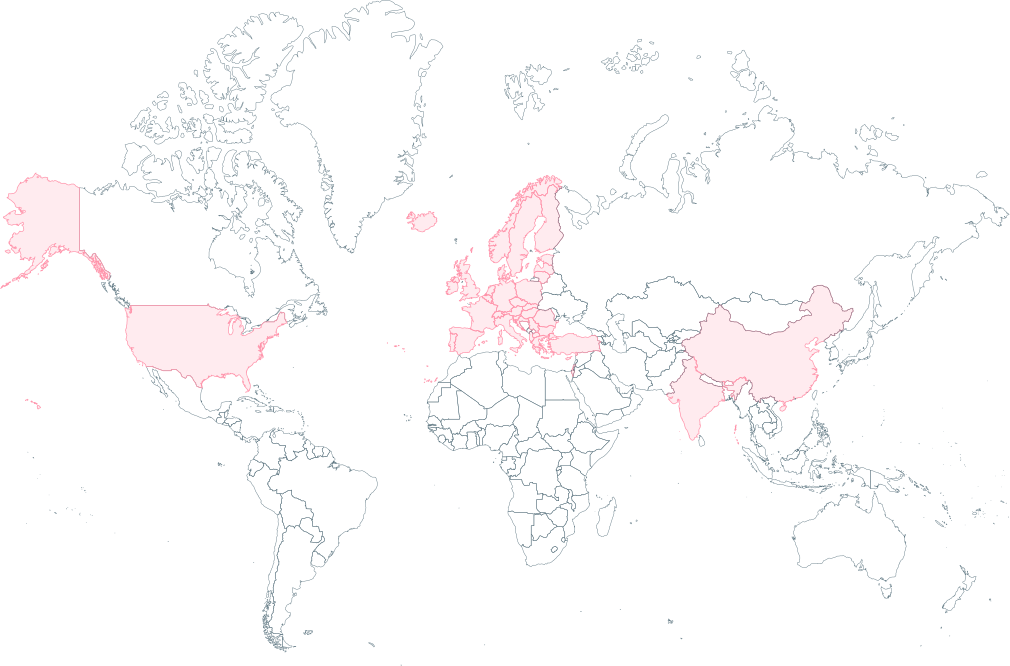
PatentGranted US / IN / IL / EP imminent (2026) / CN pending
MethodUse job parameters to fix colors on press
StatusPatent and R&D assets available for acquisition

Calculating magenta tonal value Lab curve.

L+a+b
From Your Perspective
Press Manufacturer

Press manufacturers have invested heavily over the past several years in platforms that connect presses.

The next step is control.

By connecting measurement data directly with print parameters, color can now be fixed on press, not after the fact.

For converters, this delivers faster ROI on every press: fewer makeready hours, less waste, and predictable color on every run.

Color Management

Color management should not stop at profiling and proofing.

It must extend into the press itself.

With closed-loop control, target colors are achieved on the first pull. Brand owners sign off faster.

Brand libraries finally deliver their ΔE targets, where it matters most: on press.

Inspection / Quality Control

Traditional inspection systems detect color drift.

ColorFit tells the press how to correct it.

Print parameters are adjusted in real time, keeping color stable throughout the run.

For converters, the impact is measurable: less scrap, fewer interruptions, higher yield, especially on long runs.

Savings Per Press - Calculate with your own data

EUR 200k per year (default values based on our evaluations)

By applying the ColorFit method, the following saving potentials can be achieved.

Calculate your saving potentials.

Actual efficiency
No. pulls / job
Set-up materialm
Material loss / pullm
Output / jobm
Ø Material widthm
Duration pullmin
Print speedm/min
Set-up + Downtime%
Output / day theory360000m
Eff. Output / day216000m
Actual costs
Press hour rateEUR per h
Substrate costEUR per m²
Pulls savings
Reducing bypulls / job
Annualization
Working daysdays / year
Projected8.3jobs / day
Savings
Time132.9min / day
Time cost553.85EUR / day
Material4984.6m² / day
Material cost249.23EUR / day

200,769EUR

Savings per press per year

Global market

fill in your numbers (default values related to the Siegwerk market)

Installed Printing Presses(Production Sites)Market ShareMarket VolumeYour product with EUR 5,000 license
(% of EUR savings) per press per year

Total Market

Flexographic & rotogravure presses installed in global flexible packaging

425Mio EUR
22,953(5,738)

Total Addressable Market (27%)

= Basic mature processes (%) and Digital affinity (Innovators + Moderns = %)

115Mio EUR
6,886(1,721)

Serviceable Addressable Market (8%)

= Very mature processes & modern presses (%)

34Mio EUR

Patent Status

Major market regions covered

Patent coverage by country
register
United StatesGrantedUS10838669B2
IndiaGranted201917018782
IsraelGrantedIL267007B1
EuropeImminent 2026EP17804139
ChinaPendingCN118981286A

If one wants to fix color
on press with print parameters,
this is the patent to consider.


You certainly wouldn't want to see that
at your competitor's booth at the next drupa.

ColorFit Method

Learning from inline spectrometer measurements and predicting on spectral reflectance level

Color matching is more than having the correct ink, it involves the transfer of ink onto a substrate under ambient conditions.

ColorFit isn't black box AI. It is a lightweight, physically consistent model backed by proven color science, designed to run locally on press-side hardware and also serves as an AI enabler. The ColorFit Method acts as the brain for your existing QC or Press Management software.

The ColorFit Method predicts the correct press settings before makeready and enables the operator to keep them constant through the run. The model learns from inline spectral data in relation to print parameters, substrate, ink and job information.

Three Simple Steps
Input

Defines Job Target Data (Target Lab or Spectral Reflectance Curves).

Analyze

Processes static job parameters and the allowable range of dynamic press variables.

Predict

Delivers the optimal press settings, predicted setup duration, and total estimated runtime to hit the target color.

ColorFit Method vs Prior Art

Job print data /selected printparametersDesired colorColor predictionScore sheetTest printAdjustment(present invention)Manual adjustmentby trial & error(prior art)

Applied Method and Phases

Prediction reaches TargetWithin ΔE 1time95%ofjobsLearning PhasePrediction in ActionContinuous Measurements & LearningInline Spectrometer, Ink Recipe (Viscosity, Solvents, Ratio, K/S Values),Substrate Reflectance & Properties,Print Parameters, Press Room Conditions

Science behind ColorFit

The ColorFit model predicts the optimal parameter settings that affect the printing result the most by analyzing the spectral reflectance curves of the relevant static and dynamic parameters.

Print Parameters
Static (Constraint)

Substrate, image carrier properties, ink recipe, press room environment, etc.

Dynamic (Controllable)

Printing speed, ink viscosity / solvent ratio / temperature, doctor blade settings, anilox and kiss print pressure, etc.

Showing the Impact of Print Parameters on Spectral Reflectance

For a given substrate and controllable viscosity / kiss print pressure the spectral reflectance curves with tonal values from 10% to 100% in 10% steps are predicted.

400450500550600650700Wavelength (nm)0.00.20.40.60.81.0Spectral Reflectance10%20%100%
Viscosity
minmax
Kiss print pressure
minmax

ColorFit Model backed by Color Science and Machine Learning — No magic

To establish a physically consistent foundation, the prediction model draws on well-known theories such as those of Kubelka-Munk, Yule-Nielsen and Saunderson Correction.

This allows the subproblems and their unknown parameters to be determined more efficiently and provides a broader perspective for combining the ColorFit model with other theories and methods in the industry as the distributed learning across different converters. The conclusions are transferable and can be used locally (the inference model is lightweight).

We validated the ColorFit Model on gravure and flexo presses.

Frequently Asked Questions

On the method, the patent, and the acquisition

What exactly is on offer?

The patent (granted in US, IN, IL; imminent grant in EP for 2026; pending in CN) and a set of supporting R&D-stage assets: a high-performance Rust implementation of the prediction and training model, several color science methods and optimizer, an internal research dashboard for experiment tracking and prediction analysis, supporting data-preparation tooling, the public presentation site at colorfit.ai, an interactive demo environment for walking through job selection and parameter adjustment on the Lab curve. All software is production-quality R&D — the acquirer takes it to production in their own stack. Documentation covers the algorithm, its mathematical and physical foundation, and integration paths into press, QC, or color-management software.

How does the ColorFit Method work?

ColorFit takes job-specific inputs — substrate, ink, and press conditions — and predicts the print settings that hit the ΔE target before makeready begins. The press becomes a predictable control point, not a correction step.

What is the key benefit?

For converters, the impact is measurable: less rework, faster makeready, more consistent print quality, and reduced material waste and downtime — EUR 200,000 in operational savings per press per year (see the Savings section). The result is first-time-right color matching on press.

How is the ColorFit Method different from existing color management?

Traditional color management stops at profiling and proofing, and inspection systems only detect drift after it happens. The ColorFit Method predicts the correct print parameters before makeready and adjusts them during the run, so target color is achieved on the first pull rather than chased by trial and error.

Does it require cloud infrastructure or large AI models?

No. The inference runtime is lightweight and the algorithm physically consistent — rooted in proven color science rather than large-scale machine learning, and small enough to run on press-side hardware. The patent claims describe the prediction approach, not a deployment architecture, so the acquirer is free to host inference and training wherever fits their platform.

A typical recommendation is to run training in the cloud, where measurement data from several presses can be aggregated and training jobs orchestrated across them. Inference then sits on-press, on-prem, or wherever latency and integration demand.

Which printing processes does the patent cover?

The patent claims cover the printing method itself — the scope is not limited to flexography or gravure. Validation to date has come from internal and external studies in flexo and gravure.

What measurement and data inputs are needed?

Job target data (target Lab or spectral reflectance curves), the allowable range of dynamic press variables, and inline spectral measurements. The model also incorporates ink recipe data, substrate properties, and pressroom conditions as they become available.

Who developed the ColorFit Method?

The ColorFit Method is co-developed by ColorFit GbR and Siegwerk Druckfarben AG & Co. KGaA. Both parties are joint owners of the patent, in equal shares.

Who should acquire the Patent and its R&D assets?

Press manufacturers, color-management vendors, and inspection or quality-control providers who want to extend their platforms from observation into closed-loop control. The acquisition fits parties that can integrate the method into their existing product line.

Who do I speak to about acquisition?

The inventors and representatives are listed in the Contact section. Frank Dauth (Siegwerk) and Markus Unkel (ColorFit) handle inquiries directly.

Voices Behind the ColorFit method

Avatar
ColorFit has a potential to revolutionize the print predictability in Flexo and Gravure. By leveraging advanced spectral print prediction models, it calculates the complex relationship between physical press parameters and the final color output. It transforms printing from a craft of reactive correction into a science of proactive precision - significantly cutting down material waste and the overall environmental impact.

Dr. Kiran Deshpande

Global Senior Expert Colour Management

Siegwerk

LinkedIn ↗
Avatar
ColorFit closes the gap between results of Contract Proof and Print Job. With consideration of variable print parameters color matching becomes a closed loop solution by the ColorFit prediction of optimal press settings.

Frank Dauth

Head of Global On-Site Consulting

Siegwerk

LinkedIn ↗
Avatar
Modeling the spectral reflectance behavior of printing inks on substrates on press unlocks three things: proactive setup to get first-pull right, in-run correction to react on changes, and a defined action space that lets existing process solutions converge on targets that were previously out of reach.

Markus Unkel

CEO, Owner

ColorFit

LinkedIn ↗

Contact for Acquisition

ColorFit and Siegwerk are looking for interested parties that understand the solution, can integrate the method and wish to incorporate the intellectual property into their strategic research and development.

Frank Dauth

  • Research, Business Development
  • Inventor
  • Head of Global On-Site-Consulting Siegwerk Druckfarben AG & Co. KGaA

Markus Unkel

  • Research & Development
  • Inventor
  • Founder and Representative ColorFit GbR